
2026 Q1 Blockchain Commons Report
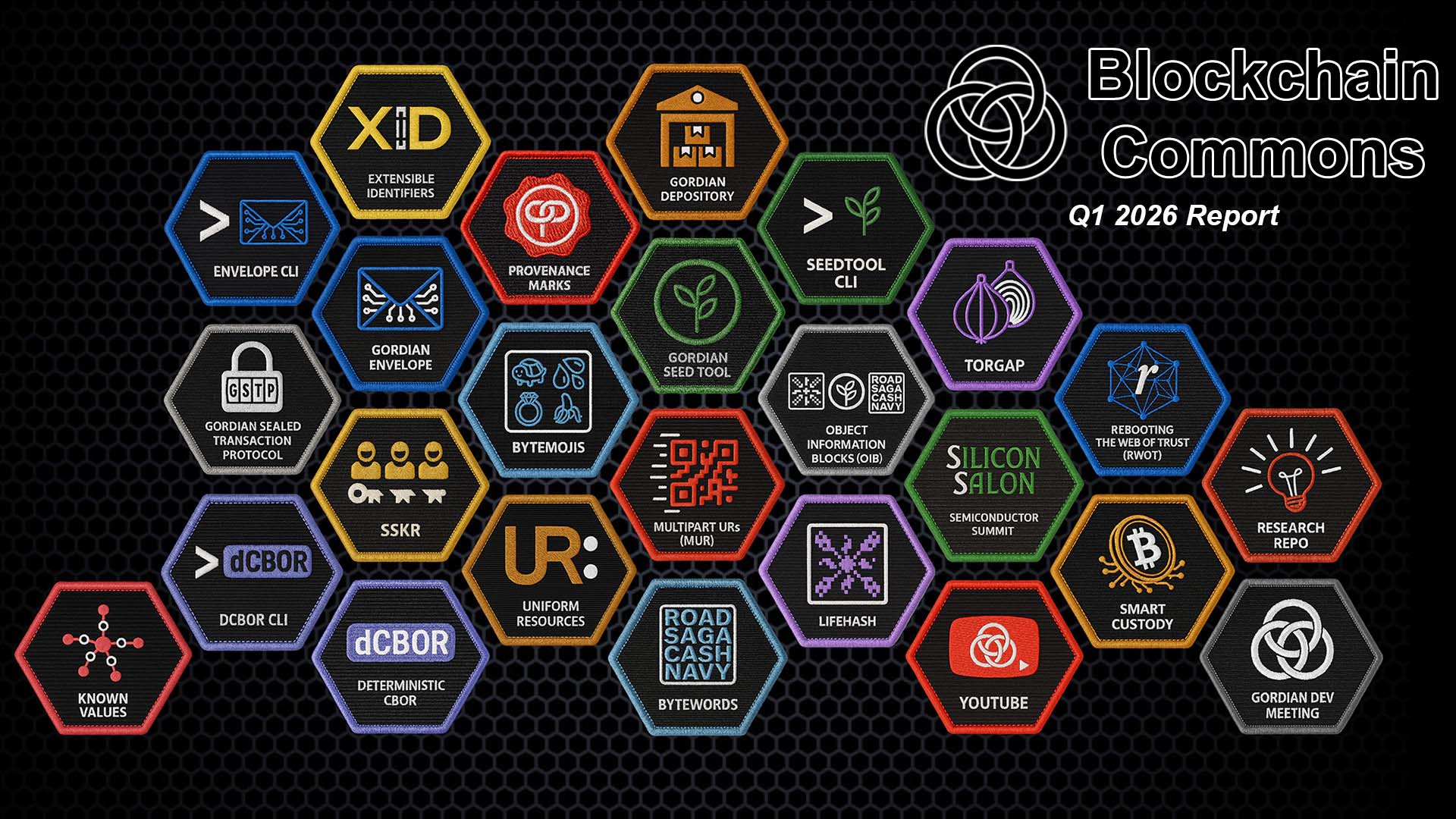
The first quarter of 2026 focused on producing a capstone for much of our stack, but also was about advancing our self-sovereign identity work. Here’s what all it included:
- Capping the Stack:
- Technology Overview
- New BCRs
- New Translations
- Playgrounds
- Locking Down Known Values:
- Talking about Known Values
- Code Point Specification
- Crate Update
- Expanding XIDs:
- Introducing Edges
- Learning XIDs
- XIDs & Garner Meeting
- Diving into SSI:
- GDC Incoming
- New Articles
- Revisiting SSI
- Returning to Learning Bitcoin:
- Learning Bitcoin 3.0
- Standup Scripts
- Gordian Server
Capping the Stack
We’ve slowly built the Blockchain Commons stack up over the last years, from dCBOR to Uniform Resources to Gordian Envelope. In 2025 and into 2026, we brought much of our foundational work to a capstone, allowing us to concentrate on new applications and references built atop that foundation, including XIDs and Gordian Clubs. Here’s some of what we did to close things out in early 2026.
Technology Overview. To celebrate the completion of our foundational work, we put together a new technology overview video that details 24 different technologies, applications, and references in about a minute each. Here’s a quick overview of all the topics covered, plus a listing of our older videos, which go into greater depth on some of these topics.
New BCRs. We also led the year off with a set of new [Blockchain Commons research papers] (https://github.com/BlockchainCommons/Research/blob/master/README.md) that were mainly intended to detail our work to date.
- BCR-2026-001: Unit, The Known Value for Deliberate Emptiness. A look at Known Value 0, and how it’s intended to be used.
- BCR-2026-002: Gordian Envelope Notation - Quick Reference. We’ve long provided a special “envelope notation” output to offer a human-readable view of what’s in a Gordian Envelope; here is its specification.
- BCR-2026-004: Envelope Salted Values. A discussion of the use of salt for decorrelation in Gordian Envelope.
(BCR-2026-003 is missing from this list because it was a major new specification, as discussed in “Expanding XIDs”, below.)
New Translations. Finally, we also produced some AI-supported translations of our stack to Swift, Kotlin, TypeScript, C#, Go, and Python. This is a preview that isn’t release-ready, and it only goes up to Provenance Marks (meaning that it’s missing some newer tech such as XIDs and GSTP). If you think this might be of use to you, talk to us about funding its full development.
Playgrounds. The third-party playgrounds that have appeared for our specifications in the last several months definitely represent another sort of capstone, as they provide a new way for developers to work with our technologies. Our January Gordian meeting included a demo of the BCTS playground. Both it and the BC-UR playground provide great tools to work with our tech.
- BCTS Playground - Data Playground, Registry Browser, Envelope Builder, XID Tutorial
- BC-UR Playground — Converter, Multi-UR & QR Generator, QR Scanner, Registry Browser
Locking Down Known Values
One of our foundational technologies is the Known Value. It’s a simple enough concept: a registry of 64-bit integers that represent common concepts. But, they’re very useful: not only do Known Values standardize our own organization of information in Gordian Envelope, but they also support that standardization across many companies. We did a variety of work on Known Values in early 2026.
Talking About Known Values. In our January Gordian Meeting, we talked about our desire to expand Known Values beyond the core concepts that we have defined for our own specifications. We wanted to not only incorporate other ranges of defined concepts, for standardization, but also to give our community the opportunity to officially define values for their own use. We got great feedback during and after the meeting that helped us to decide where the community values should go in the range. (Community feedback has always been crucial to Blockchain Commons, to ensure that what we’re doing makes sense in the world of actual development and deployment, and this was a fine example, because we’d been thinking about placing community known values too high, requiring too many bits.)
Code Point Specification. The free-for-all community band of known values starts at 100,000, but thanks to that meeting we’ve now defined a new set of community known values available with specification, which appear in the range of 1,000-1,999. Known values for this range may be submitted by PR. Our registry now also recognizes a variety of other schema, starting at code point 2,000.
Crate Update. The Known Values Rust crate has been updated to support these new code point specifications. The Blockchain Commons values remain in the core crate, but if you want to add in all the other values from our registry, just grab our current files defining them in JSON and add them to your ~/.known-values directory. You can also add arbitrary known values of your own by matching the format of our known value JSON assignment files. The known values crate (and crates that depend on it such as our envelope crate) will all have access to the values from your ~/.known-values directory.
Expanding XIDs
One of our largest current projects is XIDs, which we see as a true self-sovereign identifier. We supported them with both public demos and in-house extensions over the course of Q1.
Introducing Edges. Credentials, endorsements, and other types of attestations have always gone hand-in-hand with digital identity, and we’ve been thinking for a while about how to best expand XIDs to support these crucial digital tokens of trust. We were considering somewhat ad hoc means for a while, but we finally came up with the concept of “edges”, which are attestations that lie between two XIDs, forming the literal edges of a Web of Trust graph. BCR-2026-003 has all the details on how edges work.
Learning XIDs. You can also find edges in chapter 3 of our brand-new course, “Learning XIDs from the Command Line”. We’ve completed four chapters to date, and have put a temporary cap on the work. To date, those chapters cover: an introduction to XIDs, how to make claims related to XIDs, how to incorporate claims into XIDs using edges, and how to manage your XID with more complex elements such as commitment lists and updated views and editions. We plan to return to this course in Q2 with a new chapter on keys, but for now it’s complete and coherent.

XIDs & Garner Meeting. Finally, our public demo focused on using XIDs with Garner, our Tor onion service intended for the distribution of self-sovereign identity files. XIDs offered the opportunity to truly control your digital identity, from creating it yourself to deciding what you want to distribute. Garner makes that distribution self-sovereign as well by providing a communication method that’s very resistant to censorship, correlation, and coercion.
Diving into SSI
Our focus on self-sovereign identity (SSI) has been on the rise in 2025-2026, but it’s not actually new. We’ve been a part of the SSI community since Christopher Allen popularized the term as part of the Rebooting the Web of Trust workshops. It’s just that prior to 2025, we were still creating those foundational techs that we’re now bringing to a capstone; it’s only recently that our stack has matured enough that we can produce SSI-focused technologies such as XIDs and Gordian Clubs. Much of our SSI design is centered on XIDs themselves, but we’re also doing other work on the topic.
GDC Incoming. Blockchain Commons has been invited to the Global Digital Collaboration Conference as a co-organizer. This means that we can get you an invitation to the exclusive gathering and also help to set the agenda. Want to join us in Switzerland? Have a topic that you think is important to cover? Let us know.
New Articles. Meanwhile, Christopher has authored a few new articles on the topic of SSI, both in his Musings series (focused on original architectural designs & patterns) and in his new Dispatches series (responding to others’ discussions of topics of interest to us). Here’s his new writing from Q1:
- How XIDs Demonstrate a True Self-Sovereign Identity. How SSI has gone wrong and why XIDs are different.
- Progress toward a State-Endorsed Identity (SEDI) in Utah. Can state-endorsed SSI really be a thing? Utah offers a great model.
- Fighting Technology Paternalism. SSI is about controlling your digital destiny, but Martina Kolpondinos offers the flipside: when the computer chooses for you.
Revisiting SSI. April 26 marks the 10th anniversary of Christopher’s article, “The Path to Self-Sovereign Identity”, which popularized the term and its goals. We’ve been working on Revisiting SSI to try and reconsider the original 10 principles of SSI. We’ve had some meetings with some great input, but we’ve also found it hard to turn that into group articles the way we’re able to in a physical meet-up like Rebooting the Web of Trust. Nonetheless, we plan one or more articles on the principles and how they may have changed or how we may be thinking about them differently a decade later. If you have any opinions, again let us know! We expect to be producing some new content on the topic for Q2.
Learning Bitcoin
Learning Bitcoin from the Command Line is one of Blockchain Commons’ oldest endeavors, started with support from Blockstream even before Blockchain Commons was founded. However, Bitcoin continues to evolve rapidly and as a result the course has gotten out-of-date over the last several years. We’re thrilled to return to it in a year-long effort in 2026 thanks to a grant from the Human Rights Foundation.
Learning Bitcoin 3.0. We have begun work on Learning Bitcoin 3.0, which is a thorough update of the course, focused on better incorporating newer elements such as Signet, descriptor wallets, Segwit, and Taproot, as well as a check and/or revision of every single line of code. We’ve logged a week and a half of work on this to date, and have it scheduled for five weeks total. Our log of work to date and our plans for the future are all in our TODO file, while the lbtcftcl-v3.0 branch of Learning Bitcoin contains the 264 commits to date. At the moment, §1.0-§7.2 are pretty solid. As soon as we close out chapters 7 & 8 and their linked discussions of multisigs and PSBTs, we plan to make the updated version of the course more available with a mkdocs-formatted website (but it’ll be the end of the year before we close out the project entirely). Thanks again to HRF for enabling this much-needed work!
Standup Scripts. Our Standup Scripts guide the creation of UNIX machines running the Bitcoin Core server. We used them in the LBTCftCL course and to produce that course. But these Scripts tend to age badly over time, as the programs we use change. We updated our Standup Scripts in January to support Bitcoin Core 25.0 and Debian 13. Ironically, the StackScript version of our scripts has already decayed because of some Linode package management that is now requiring user intervention. But, the non-StackScript version still works great (and you can run it from a Linode by hand), and we’re deciding on the best solution for the StackScripts. (Removing certain package updates resolves the problems, but keeping packages up to date is a best practice, so we’re hoping that what appears to be a bug gets resolved!)
Gordian Server. The new work on Learning Bitcoin also made us reconsider the Gordian Server, our Bitcoin Server for the Mac, which we also use for testing when we’re working on Learning Bitcoin. It too had gotten out of date, but its original designer, Peter Denton, has been working on his own iteration of the concept, the Fully Noded Server. As a result, we’ve officially deprecated Gordian Server and now suggest the use of Pwrwe’a Fully Noded Server instead. (Notes on the one alias needed to make things work well for the Learning Bitcoin course are already incorporated into v3.0 of the course.)
Final Notes
The environment for work on self-sovereign digital assets and identity continues to be rough in 2026. Due to limited resources, we expect to be focusing more in the coming year on developing, polishing, and documenting our existing work, as opposed to creating some of the exciting new technologies that we saw in 2025. That’s not a bad thing, as it’ll give us a chance to really get XIDs, Gordian Clubs, and other recent technologies into the ecosystem, alongside our already adopted specifications such as Gordian Envelope and URs.
But, you can help. We are looking for partners who want to adopt our technologies and who could use our expertise to do so. Drop us a line if that’s you. We of course continue to welcome individual and small company sponsorships as well. If you want to see this work continue, and if you can lend your reputation to ours, please sign up as a recurring GitHub sponsor.