2026 Q3 Blockchain Commons Report
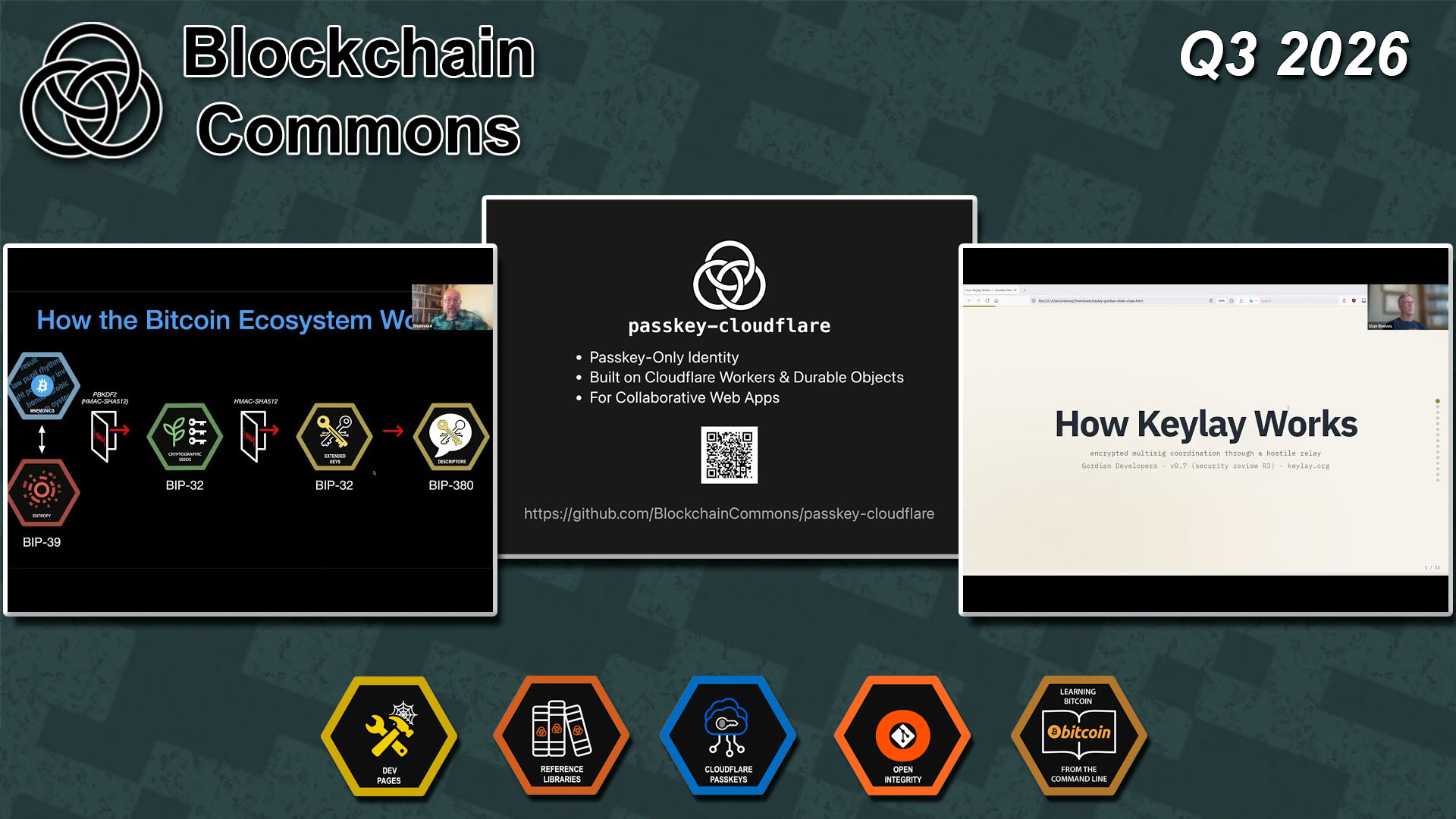
Here’s some of our newest work at Blockchain Commons for summer 2026.
Keys & Commits:
- Cloudflare Passkeys
- Keylay Demo
- Open Integrity / AI
New Libraries:
- Typescript
Learning Bitcoin:
- Sharding Secrets
- Miniscript
- Taproot
Updating Dev:
- Technologies
- Architecture
- Touchpoints
Grant Requests:
- Ethereum
- Lots of Learning
Keys & Commits
Some of our biggest projects in Q3 focused on keys and their relationship to identity and the rest of the digital ecosystem.
Cloudflare Passkeys. Blockchain Commons debuted its new Passkey-only identity, passkey-cloudflare, which is also available as a live demo. The Passkeys verify an identity, with multiple Passkeys available to any user. We hope to use this as the foundation of authentication in CSR and other systems.
Keylay Demo. We’re always happy to spotlight other work being done in the ecosystem that supports the self-sovereignty of users, so we were happy in August to host a demo of Keylay, an online multisig coordinator that can make resilient control of Bitcoin assets into a reality.
Open Integrity / AI. At the Gordian meeting where we talked about the new Passkey system, we also opened a discussion on how we should be recording the use of AI in Git repos. For us, much of this bound up in the use of Open Integrity, a system that improves the accountability of Git repos, but it grows more complex when an AI with a key can sign a thousand things (or more!) in a day. One of our suggestions? AI can only make changes to branches, which may be incorporated into main only by humans who verify everything.
New Libraries
Blockchain Commons’ libraries make the Gordian Stack available to developers.
Typescript. Leonardo Custodio and Parity Technologies have been offering some great support for Blockchain Commons for a while. This quarter, they started pushing over the typescript libraries they’ve created, so that we can offer them to the community. Things kicked off with bc-dcbor-ts early in the quarter, but as of this writing they’ve shared almost 20 typescript libraries, covering most of the Gordian Stack, including foundational technologies such as SSKR, Lifehash, and Gordian Envelope.
Learning Bitcoin
We have been continuing work on a new edition of Learning Bitcoin from the Command Line, our very popular Bitcoin developer course, thanks to a grant from HRF.
Besides the revisionary work, getting everything up to date with Bitcoin Core 31.1, we’ve also been releasing brand-new chapters on new concepts.
Sharding Secrets. Last quarter we mentioned our first new chapter, “Working with Secrets”, which demonstrates how to use technologies like Gordian Envelope and the Gordian Reference Apps to make your assets more resilient. We thought it powerful enough that we’ve since turned it into a video presentation.
Miniscript. Our second full new chapter is “Using Miniscript”, which talks about the new(er) ways to represent Bitcoin Script: Miniscript and Policy. This also allowed us to introduce the BDK toolkit, another great command-line tool for Bitcoin.
Taproot. Our final big expansion for Learning Bitcoin is a series of chapters on Taproot and the new signatures it supports such as FROST and MuSig2. Our introductory chapter is fully available, while we’re working on closing out work on MuSig2 and Tapscript sections.
Bitcoin Standup. Finally, Learning Bitcoin work has again caused us to upgrade our Bitcoin Standup Scripts, this time to Bitcoin Core 31.1.
Updating Dev
Our Developer Pages have long been a top resource for people wanting to adopt Gordian Stack technologies. We largely finished our massive revamp of these web pages in Q3.
Technology. Our new technology section is done. Along with our overview video, it includes categories for data formats, data resilience, digital identity, digital signatures, and secure communications, plus Blockchain specific work (currently limited to Bitcoin, Ethereum, and Zcash). We had this underway in Q2 and are thrilled to have closed it out (and hope the new organization is clearer than our previous attempt to pile everything up in the same stack).
Architecture. Tech is just the front-facing part of Blockchain Commons’ work. It’s all based on specific architectural designs. Our new architecture page talks about how we build up from principles to philosophies to patterns, mirroring our concepts in both software and network design.
Touchpoints. We’re aware that the Gordian Stack is pretty huge. In less than 10 years we’ve developed technologies to solve a variety of problems related to independence, resilience, privacy, and openness, and it can be hard to figure out how to get started with it all! As a result, we’re developing a series of Touchpoints meant to highlight relevant technologies for a variety of developers. Our first one spotlights technologies for self-sovereign identity designers. Though the rest of the developer pages are 99% done in their updated form, we expect to add more touchpoints in the coming months. (If there’s one you want to see, let us know)
Grant Requests
We have continued to look for grants to support our work. If you know of grants that might be appropriate for us, let us know, and if your company is interested in working directly with us on some of these topics, let us know.
Always Learning. We have pitched a few different learning courses, including “Learning BDK from the Command Line”, “Learning Lightning from the Command Line”, and “Smart Custody v2.0”. Again, if these topics are of interest to you, or if there are similar topics that we could use to advance our Gordian Principles while also supporting something of interest to you, drop us a line.
Ethereum. We have long considered Ethereum as a great methodology for advancing our work and hope to have more on that in our year’s end report.
That’s it for now! Join us at Gordian Meetings to stay up to date on our work!